Technology
Microfluidic Diffusional Sizing (MDS) is an in-solution analytical technology for quantifying the hydrodynamic radius Rh of biomolecules and characterizing biomolecular interactions under near-native conditions. The method is based on the diffusion of fluorescently labelled molecules within a microfluidic chamber, where two laminar streams flow in parallel. Because of diffusion relationship with the molecular size, the rate of diffusion of target protein from one stream to the other depends on the target’s molecular size.
In MDS, the labelled target is introduced into the microfluidic diffusion plate together with an auxiliary fluid. The relative fluorescence intensity measured at the end of the diffusion chamber is used to calculate diffusion behavior and, from this, the hydrodynamic radius of the unbound target molecule and target-ligand complex.
When measured across a titration series of a ligand, size changes can be used to derive binding curves and determine equilibrium dissociation constants (KD) of a specific target-ligand interaction.
Labeled sample
Labeled protein target
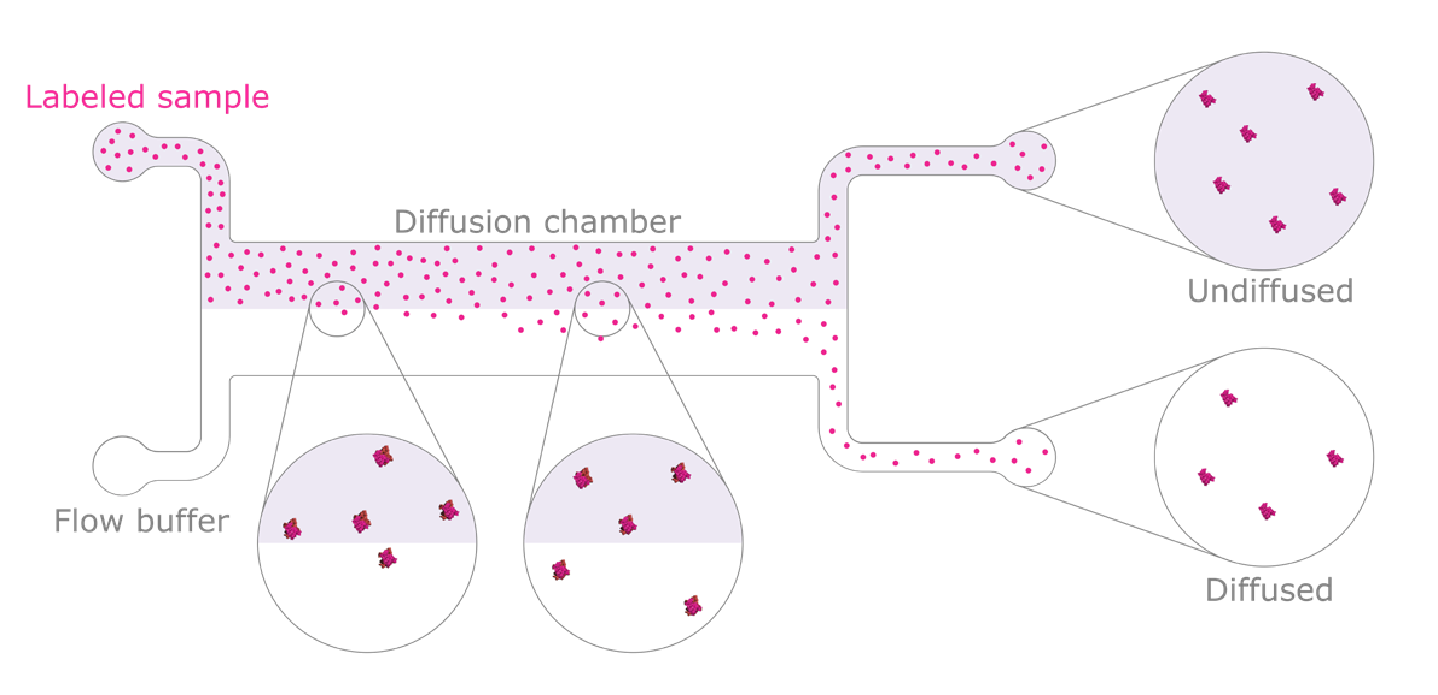
Labeled protein target with interacting partner present
Beyond affinity determination, MDS enables calibration-free quantification of active binding site concentration by measuring binding at different concentrations of the labelled species. These concentration measurements can also support the determination of binding stoichiometry, extending the assay output beyond conventional interaction analysis.
In a single workflow, MDS can provide hydrodynamic size, binding affinity, concentration, and stoichiometric information.
Adventages
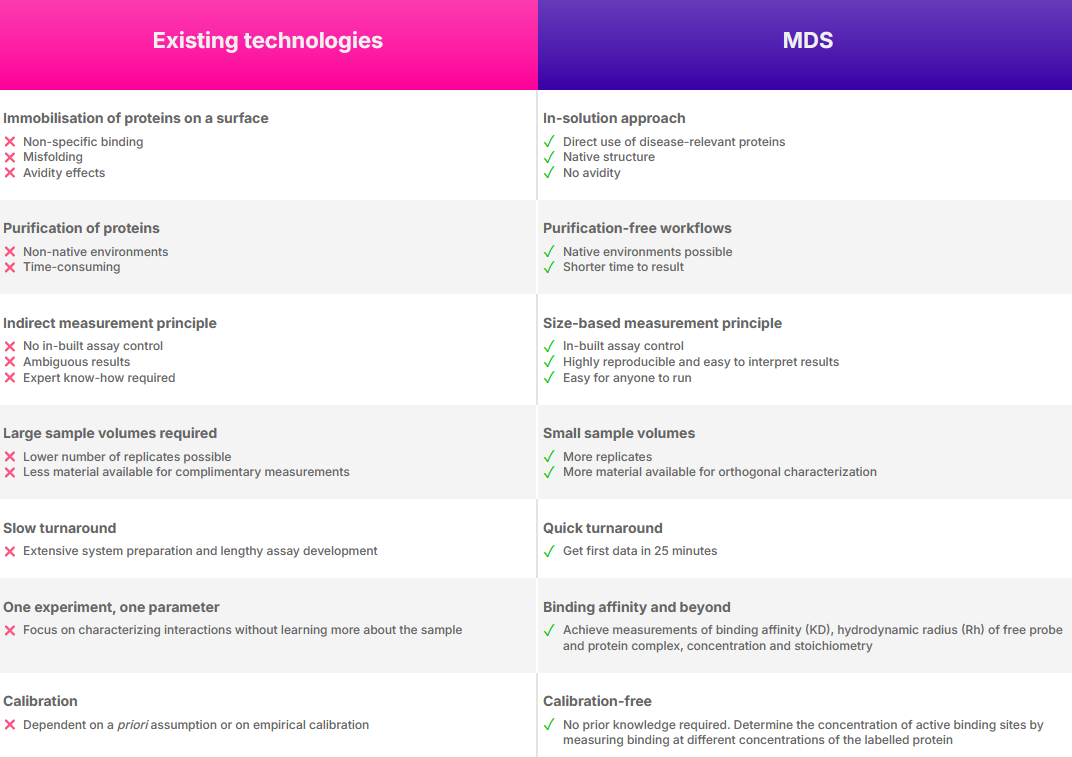
A key advantage of MDS is that it avoids immobilization, purification, and assay calibration, thereby reducing artefacts associated with surface binding, protein misfolding, avidity effects, and non-native sample preparation. This enables direct analysis of biomolecules in solution and in complex biological matrices, including serum, plasma, cell lysates, tissue homogenates, fermentation broth, and crude membrane preparations.
Because the measurement principle is size-based and performed entirely in solution, MDS is particularly well suited for challenging targets that are often difficult to study with traditional biophysical techniques, such as membrane proteins, disordered proteins, amyloid fibrils, polyclonal antibodies, bispecific antibodies, PROTACs, and other heterogeneous or weakly behaving systems.
The workflow requires low sample volumes and can deliver first data in as little as 25 minutes, supporting rapid and reproducible characterization across basic research, drug discovery, and translational applications.